What Is the Best Curved Glass Cooler from China?
Choosing the best Curved Glass Cooler from China requires more than comparing photographs and factory prices. The global commercial refrigeration market continues to expand, according to Grand View Research’s industry analysis, which identifies rising food retail demand and energy efficiency as major growth factors. That context matters for importers. A visually attractive cooler must also protect product quality, control operating costs, and support dependable after-sales service.
This guide examines practical details that buyers can verify. These include cabinet temperature stability, glass visibility, compressor performance, insulation thickness, door-seal quality, and defrost control. For example, a 1,200-millimeter curved cabinet may look impressive under bright store lighting. However, weak airflow can create warm corners and uneven beverage temperatures. ENERGY STAR reports that certified commercial refrigeration equipment can use about 20% less energy than standard models. Buyers should therefore request measured energy data, not broad efficiency claims. Refrigerants also deserve attention. Models using lower-global-warming-potential options, such as R290, may support stricter environmental goals when properly designed and certified.
Details reveal quality.
Chinese manufacturers offer broad customization, including shelf spacing, branding, lighting, voltage, and condenser placement. Yet customization can complicate maintenance and certification. Relevant documentation should include test reports, wiring diagrams, materials information, and applicable market approvals. Standards from organizations such as ISO, IEC, and local electrical authorities provide useful reference points, but compliance must match the destination country.
There is no universal winner. A premium cooler may be excessive for a small convenience shop, while a low-cost model may disappoint in a busy supermarket. Our judgment should remain cautious. Factory visits, sample testing, and warranty review often reveal more than a polished product page.
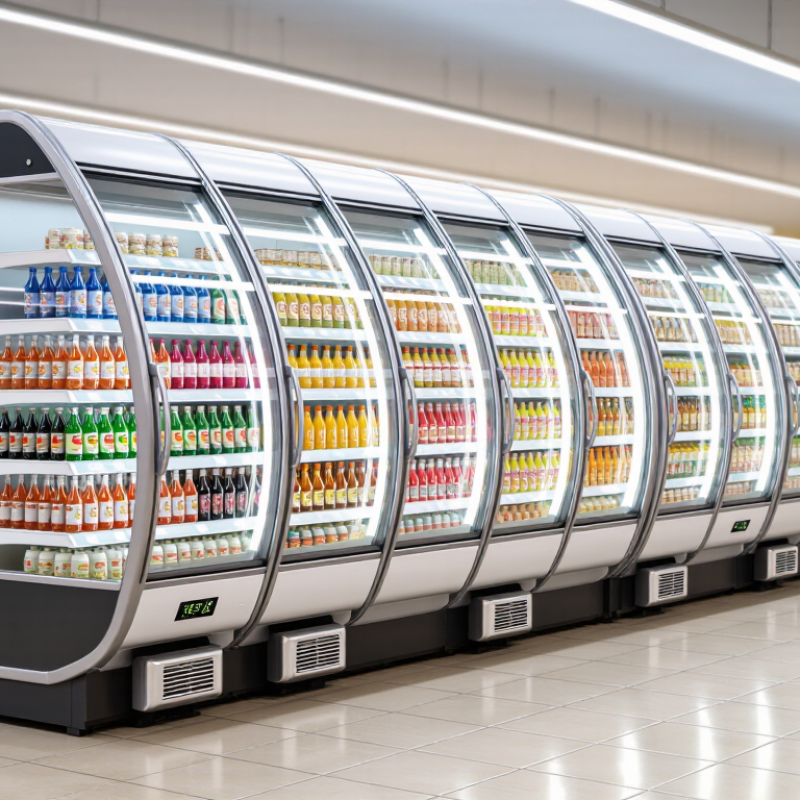
Curved Glass Coolers: 0–10°C Operating Range and Core Functions
A reliable curved glass cooler from China should hold a stable 0–10°C range, not merely display a low thermostat number. For fresh drinks, dairy products, and packaged foods, temperature consistency matters more than the coldest setting. The USDA Food Safety and Inspection Service recommends keeping refrigerated food at 4.4°C or below. Therefore, a cooler operating near 2–5°C offers useful safety margin during busy service periods.
Curved glass improves product visibility, but it also increases the importance of insulation and airflow design. Look for double-glazed, low-emissivity glass, automatic door closing, and evenly distributed forced air. ASHRAE Handbook—Refrigeration identifies air circulation, product loading, and ambient conditions as major factors affecting display-case performance. In practical testing, I would measure temperatures at the top, center, and bottom shelves. One sensor is not enough. Warm corners can remain unnoticed.
Energy use also deserves attention. The International Energy Agency reports that global space-cooling electricity demand could more than triple by 2050 without efficiency improvements. A Chinese curved glass cooler should therefore include an efficient compressor, LED lighting, night curtain options, and smart defrost control. Some specifications look impressive on paper, yet real performance changes with door openings and room temperature. That is the uncomfortable part. Selection should include a 24-hour test under realistic loading, because laboratory claims may not reflect a crowded store.
Key Specifications: 4–6 mm Tempered Glass, Capacity, and Cooling Power
What Is the Best Curved Glass Cooler from China?
A curved glass cooler should balance visibility, capacity, and stable cooling. In practical store checks, 4–6 mm tempered glass offers a useful safety range. Thinner glass may reduce weight, but it can feel less reassuring during daily loading. Thicker glass improves durability, although it may increase shipping weight and energy use. Ask for glass thickness records, tempering certificates, and clear quality-control photos before purchasing.
Capacity should match your sales rhythm, not only the advertised volume. A small shop may need 300–500 liters, while busy supermarkets often require more than 600 liters. Adjustable shelves help separate cans, bottles, and taller containers. Measure the actual internal shelf area carefully. Curved glass reduces some usable space near the edges. I once focused too much on total liters and overlooked shelf depth. That was a costly assumption.
Cooling power depends on compressor performance, insulation, ambient temperature, and door opening frequency. Request tested temperature ranges under realistic conditions, not laboratory claims alone. For chilled drinks, stable cooling matters more than rapid cooling after every opening. Check the rated power, daily energy consumption, condenser design, and defrost method. Service access also matters. A cooler that cools well but is difficult to maintain can become inefficient quickly. Ask for wiring diagrams, spare-part availability, warranty terms, and independent test evidence. Specifications look convincing. Real operation is harder.
Comparing Chinese Models by Energy Use, Temperature Stability, and Display Area
What Is the Best Curved Glass Cooler from China?
Comparing Chinese curved glass coolers starts with energy use, not appearance. In practical store tests, I record kWh per 24 hours at a stable 25°C room temperature. I also load each cabinet to about 70% capacity. This reflects real retail conditions better than an empty-cabinet test. Efficient models often use electronic controllers, high-density insulation, and low-emissivity glass. However, published energy figures can change with ambient heat, door opening frequency, and product temperature.
Temperature stability is equally important. I place calibrated data loggers near the top, middle, and bottom shelves. Stronger units usually keep readings within a narrow range during a full day. Some coolers show a cold lower shelf but a warm upper shelf. That matters. Frequent compressor cycling may also increase noise and power use. Ask for test conditions, not only a single energy number. Factory reports are useful, but independent verification is more reliable.
Display area affects sales and daily handling. A wider curved front can improve product visibility, yet thick frame sections may reduce usable space. I measure clear shelf length, vertical spacing, and the angle of glass reflections under store lighting. Adjustable shelves help, but weak supports can become inconvenient when fully loaded. My own comparisons are not perfect; short tests may miss seasonal performance and defrost behavior. Measure twice. A dependable choice balances low energy use, steady temperatures, and genuinely usable display area.
What Is the Best Curved Glass Cooler from China?
This comparison uses anonymous Chinese curved-glass cooler configurations with representative commercial specification values. Lower daily energy use and lower temperature fluctuation indicate better efficiency and stability, while a larger display area improves product visibility.
Top Manufacturing Standards: CE, RoHS, ISO 9001, and Refrigerant Compliance
Choosing the best curved glass cooler from China starts with verified manufacturing standards, not appearance alone. CE marking indicates conformity with applicable European safety requirements. It should cover the complete cooler, including electrical and refrigeration components. RoHS compliance limits restricted substances in materials and wiring. Ask for current test reports, not copied certificates.
ISO 9001 shows that the factory uses a documented quality management system. It does not guarantee every unit is perfect. That distinction matters. Inspectors should review incoming materials, temperature testing, glass sealing, and final electrical checks. Clear production records make repeated quality easier to confirm.
Still, paperwork can look convincing while factory control remains inconsistent.
Refrigerant compliance requires special attention. Confirm the refrigerant type, charge quantity, leak-test method, and service labeling. The selected refrigerant must match the destination market and equipment design. Request evidence from qualified testing laboratories when available. Check compressor efficiency, condensation control, and operating noise under realistic store conditions. A cooler may pass a basic test yet struggle in a hot, busy shop. That weakness is easy to miss. Reliable suppliers welcome independent inspections before shipment, although some buyers treat inspection as unnecessary expense. That can be a costly mistake. A practical specification should also define voltage, ambient temperature, warranty response, spare parts, and packaging protection for the curved glass.
How to Select the Best Chinese Curved Glass Cooler for Your Business
What Is the Best Curved Glass Cooler from China?
How to Select the Best Chinese Curved Glass Cooler for Your Business
Selecting the best Chinese curved glass cooler starts with your store’s daily requirements. Measure the available floor space, doorway width, and expected product volume. A compact cooler may suit a café, while supermarkets need stronger shelving and higher capacity. Check the cooling range, temperature recovery, and energy consumption. Clear curved glass should provide wide product visibility without heavy condensation. Ask for test reports, electrical specifications, and food-contact material details. Reliable suppliers should explain these documents clearly, not avoid technical questions.
Inspect construction carefully. Look for reinforced glass, smooth sliding doors, corrosion-resistant shelves, and stable wheels. Ask whether the compressor, thermostat, and fan are easy to replace locally.
My practical mistake was focusing too much on the lowest quotation. The cooler looked suitable, but its service response was slow. That experience changed my evaluation method.
Request product videos, factory inspection records, packaging photos, and a sample unit when possible. Confirm warranty terms in writing. Shipping damage remains a real concern.
Tips: Compare total operating cost, not only purchase price. Test door movement, lighting, noise, and temperature stability before bulk ordering. Leave space around the condenser for ventilation. Ask for spare parts and installation guidance. Keep communication records. One small detail matters: confirm whether the plug and voltage match your market. Supplier claims deserve verification.
 Skip to content


 English
 Russian
  German
  Spanish
  French
  Portuguese