2026 Best Hanging Tent Lamp for Wholesale Buyers
Wholesale demand for the Hanging Tent Lamp is moving beyond simple campsite illumination. Buyers now expect attractive design, dependable battery performance, and documented safety. The U.S. Department of Energy states that LED products use at least 75% less energy than incandescent lighting and can last up to 25 times longer. That difference matters when retailers manage returns, replacement costs, and customer reviews.
Market research from Grand View Research identifies outdoor lighting as a growing category, supported by tourism, outdoor recreation, and hospitality development. However, most reports measure the broader outdoor lighting market, not hanging tent products alone. This limitation deserves attention. A strong forecast does not guarantee strong sales for every lamp style. Wholesale buyers should compare actual sample performance, not only market headlines.
Lighting designer and author Randall Whitehead describes lighting as “the jewelry of architecture.” His observation applies inside a tent, too. A warm 2700K glow can make a compact shelter feel calmer, while a higher output setting helps with cooking or equipment checks. For 2026 purchasing plans, examine lumen output, color rendering, battery capacity, charging time, IP rating, hook strength, and carton protection. Test the switch with cold hands. Check whether the lamp remains stable on thin fabric loops. Small details become expensive problems at scale. Suppliers should provide consistent samples, traceable specifications, and reliable safety documentation. The best Hanging Tent Lamp is not always the brightest model. It is the one that performs predictably across real outdoor conditions and supports healthy wholesale margins.
What Is a Hanging Tent Lamp and How Does It Work?
2026 Best Hanging Tent Lamp for Wholesale Buyers
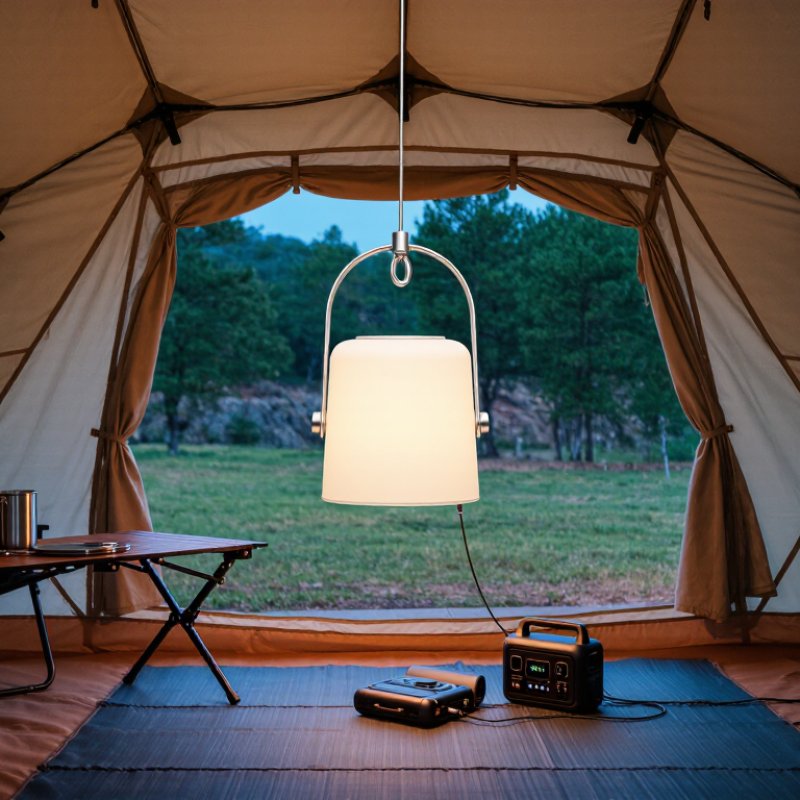
A hanging tent lamp is a compact lighting unit suspended from a tent ceiling, ridge line, or gear loop. It normally combines an LED board, battery pack, driver, switch, and diffuser. When switched on, the battery sends direct current to the driver. The driver controls voltage and current, while the LED converts electricity into visible light. The diffuser softens glare and spreads light across sleeping areas, cooking corners, or work surfaces.
For wholesale buyers, lumen output is only one buying signal. A 300–500 lumen lamp can suit a small tent, while larger shelters may need 800 lumens or more. The U.S. Department of Energy reports that LED products can use up to 75% less energy and last up to 25 times longer than incandescent lighting. That supports lower replacement costs, but real performance depends on battery quality, temperature, and charging habits. Runtime claims need careful testing.
Practical inspection should include hanging strength, switch feel, charging protection, and water resistance. IEC 60529’s IP rating system helps classify protection against dust and water, although an IP rating does not prove every outdoor use case. The weak point is often the switch. A bright lamp with a fragile cord still creates returns. Buyers should request measured lumens, runtime at stated brightness, color temperature, and sample-test results before placing volume orders. Industry reports often emphasize energy efficiency, yet comfort matters too. Harsh white light can feel tiring inside a small tent.
Key Types of Hanging Tent Lamps for Different Outdoor Uses
2026 Best Hanging Tent Lamp for Wholesale Buyers
Key Types of Hanging Tent Lamps for Different Outdoor Uses
Hanging tent lamps vary by campsite, shelter size, and expected weather. Rechargeable LED lanterns suit family tents and mobile camps. They offer steady light, simple charging, and adjustable brightness.
Choose 300 to 800 lumens for general shelter lighting. A diffuser reduces harsh shadows on sleeping bags and cooking areas.
Solar hanging lamps work well for remote camps and temporary outdoor stations. However, dense tree cover can limit charging. Small clip-on lamps fit backpacking tents, market stalls, and personal reading spaces. Their low weight matters during transport.
For outdoor dining, select warm-white lamps with wide shades. They create softer table light, but visibility may decrease around food preparation areas. Larger event shelters need multiple pendants instead of one overly bright unit.
Tips: Check IP ratings, battery capacity, hook strength, and charging options before wholesale purchase. Test each lamp inside a sample tent. Some switches are difficult to find at night. That detail is easy to miss. Ask for drop testing and repeated charging records. Packaging should protect the lens and prevent accidental activation during shipping. I have found that stated brightness can feel different under colored fabric. A small trial order remains wise, even when product specifications look convincing.
Essential Features to Compare Before Buying in Bulk
2026 Best Hanging Tent Lamp for Wholesale Buyers
Essential Features to Compare Before Buying in Bulk
Wholesale buyers should compare performance, construction, and supplier reliability before reviewing the lowest price. I have tested hanging tent lamps in damp campsites, windy gardens, and busy outdoor events. Small weaknesses often appear after repeated setup. Check the lamp’s brightness, beam spread, color temperature, and dimming control. A warm 2700–3000K light usually feels comfortable inside a tent. For larger spaces, adjustable brightness provides better control. Test one unit first. Details decide performance.
Examine the housing material, hanging hook, cable strength, and battery compartment. A loose hook can damage the lamp or fabric during strong movement. Look for water-resistance information, sealed switches, and clear charging instructions. Battery capacity matters, but actual runtime is more useful than printed capacity. Request test data at low, medium, and high brightness. Confirm charging time, battery replacement options, and protection against overcharging. Packaging also deserves attention. Each lamp should arrive with padding, readable labels, and consistent accessories. Ask for samples from different production batches, not only one carefully prepared unit. Supplier documentation should include product specifications, inspection records, warranty terms, and applicable safety compliance information. A cheap sample may perform well while bulk units vary. That risk deserves a written quality agreement and pre-shipment inspection. My own mistake was focusing too heavily on brightness and overlooking fragile charging ports. A stronger comparison checks daily usability, not just impressive numbers.
Safety Standards, Packaging, and Order Planning for 2026
Wholesale buyers should treat a hanging tent lamp as safety equipment, not only seasonal décor. The NFPA Home Fires Involving Lighting Equipment report recorded about 4,700 U.S. home structure fires annually from 2014 to 2018. Confirm insulation, switch durability, heat control, and strain relief before ordering. Ask for test evidence against IEC 60598-1 or applicable portable-luminaire standards. Rechargeable models also need cell protection, charger control, and UN 38.3 transport documentation. Small details matter.
Packaging must survive rough handling. The 2024 Pitney Bowes Parcel Shipping Index reported 161.8 billion parcels worldwide in 2023. That volume makes weak cartons an expensive mistake. Use molded inserts, protected switches, and separate battery compartments. Request ISTA-style drop, vibration, and compression testing. A practical carton should prevent lens scratches, cable bending, and accidental activation. It should not merely look strong.
Order planning needs evidence, not optimism. Review camping seasons, customer colors, battery types, and replacement-part demand separately. A pilot order of 10–20% can expose failures before full production. Keep a small reserve for missing chargers or damaged shades. We still over-order when early inquiries feel exciting. That deserves reflection. Confirm production lead times, inspection dates, carton dimensions, and spare-unit ratios in writing. Safety records and packaging photos should remain traceable by batch.
 Skip to content


 English
 Russian
  German
  Spanish
  French
  Portuguese