How to Choose a P65 Gobo Light for Outdoor Projects?
Choosing a P65 Gobo Light for an outdoor project requires more than comparing wattage or appearance. The fixture must produce clear projections across changing weather, viewing distances, and surface textures. A garden wall, event entrance, and building façade each demand different optical performance. Light fades outdoors. Brightness alone cannot solve that problem.
Begin by checking the manufacturer’s technical data, including lumen output, beam angle, gobo compatibility, color temperature, and operating range. Confirm what the stated P65 protection actually covers, because product descriptions are sometimes incomplete or inconsistent. Look for sealed housing, corrosion-resistant materials, secure cable glands, and a mounting bracket that remains stable in wind. In practical installations, a slightly wider beam often works better than an extremely bright narrow beam. The result feels more balanced and avoids harsh edges.
Consider the project’s power access and control method before selecting the fixture. Timers, dimming, DMX control, and remote operation can improve maintenance, especially for seasonal displays. Test the projected image at dusk, then inspect it from the audience’s actual position. I have found that daytime demonstrations can be misleading. A design that looks sharp indoors may appear weak against brick, foliage, or uneven stone. Leave room for adjustment. Even a well-specified light may need a different lens, mounting height, or gobo design after installation. Reliable choices come from verified specifications, realistic testing, and advice from qualified lighting professionals when electrical work is involved.
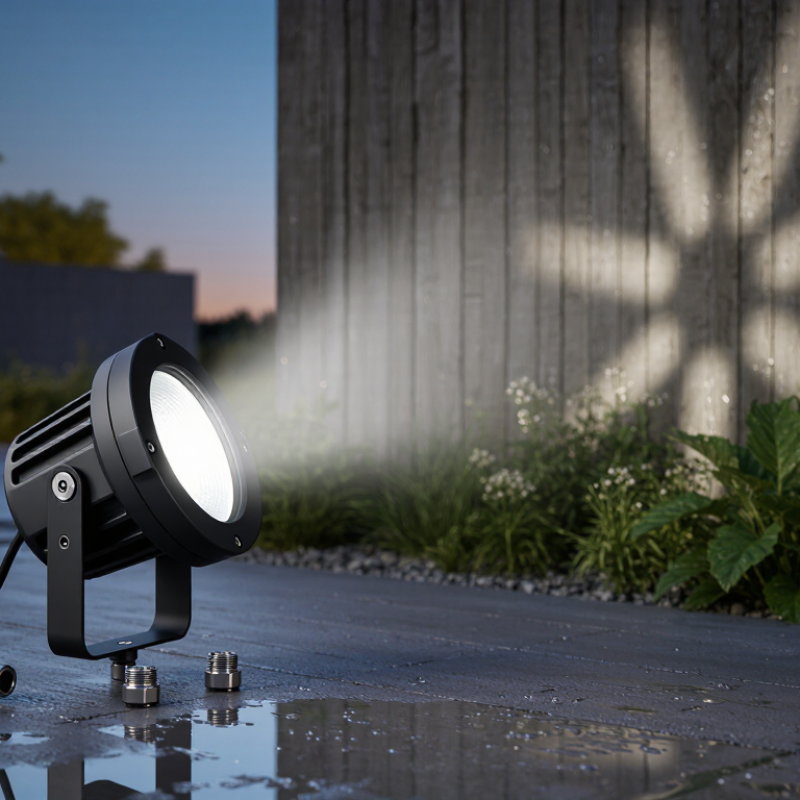
What Is a P65 Gobo Light and How Does It Work?
A P65 gobo light usually refers to a projector with IP65 protection, although “P65” is not the formal IEC marking. IEC 60529 defines IP65 as dust-tight protection and resistance to water jets from any direction. The first digit matters around dry soil and airborne particles. The second matters during rain or cleaning. Always check the product’s certification label, not only the sales description.
A gobo light works by placing a metal or glass pattern inside its optical path. The LED source creates focused light, while the lens enlarges the pattern onto a wall, tree, pavement, or temporary structure. Sharp projection depends on lens quality, beam angle, distance, and ambient light. Not just brightness. A 20-watt unit may appear stronger than a 40-watt unit when its optics are better aligned. The U.S. Department of Energy reports that LED products can use at least 75% less energy and last up to 25 times longer than incandescent lighting, supporting efficient outdoor operation.
For project selection, calculate the projection distance first. A narrow lens suits a distant façade; a wider lens covers nearby ground. Outdoor testing should include wind-driven rain, condensation, and thermal cycling. I have seen installers overlook heat around the housing, then lose image stability at night. Weather changes everything. Choose adjustable focus, sealed cable entries, and a documented IP test. Also review the manufacturer’s photometric data, because advertised brightness can be measured under ideal conditions. That detail is easy to miss, and sometimes it changes the decision.
How to Choose a P65 Gobo Light for Outdoor Projects?
What Is a P65 Gobo Light and How Does It Work?
A P65 gobo light is designed with an IP65-rated enclosure: the first “6” indicates complete protection against dust, while the second “5” indicates protection against water jets from any direction. It is suitable for many outdoor installations, but it should not be submerged.
The chart shows the ideal relative illuminance of a fixed-output gobo projector as the projection distance increases. It follows the inverse-square law: doubling the distance reduces illuminance to approximately one-quarter. Actual results also depend on lens efficiency, beam angle, ambient light, and the contrast of the projected image.
How to Assess Outdoor Lighting Needs and Site Conditions
Before choosing a P65 gobo light, inspect the site after sunset. Note mounting height, viewing distance, nearby roads, trees, walls, and reflective surfaces. A bright logo can become unwanted glare on wet paving. The International Energy Agency reports that lighting uses about 15% of global electricity consumption, so efficient selection matters beyond appearance.
Check the local weather pattern, too. Rain, dust, salt air, and temperature changes can shorten equipment life. IEC 60529 defines IP ratings, but “P65” is not a standard ingress code by itself. Confirm whether the specification means IP65, and request test documentation. IP65 indicates protection from dust and water jets, not immersion or strong coastal corrosion. That distinction is easy to miss.
Measure the projection area before selecting the lens. A narrow beam may create a sharp image but needs accurate alignment. A wider beam reduces aiming sensitivity but can spill light into windows or habitats. The Illuminating Engineering Society’s RP-33 guidance emphasizes control of glare, trespass, and sky glow for outdoor environments. The Commission Internationale de l’Éclairage also addresses obtrusive light in CIE 150:2017. Use timers, dimming, and shielding where possible. Test one fixture at the actual distance first. It may look perfect indoors and disappoint outdoors. Record surface color, texture, and nighttime brightness, then reassess after rain. Geological dust, seasonal foliage, and changing pedestrian routes can alter the result.
How to Select Beam Angle, Brightness, and Gobo Size
Outdoor gobo projects need more than a bright fixture. The beam angle controls image size and edge sharpness. A narrow 15–25° beam suits distant walls or tall facades. A wider 30–45° beam covers larger surfaces from shorter distances. Measure the throw distance before ordering.
Brightness depends on ambient light, projection distance, and surface color. Dark brick absorbs light, while pale concrete reflects it strongly. For a small courtyard, moderate output may be enough. Large buildings usually need higher lumen output. Avoid choosing the brightest option automatically. Excessive brightness can wash out fine gobo details. I once underestimated nearby street lighting, and the image looked weak after sunset.
The gobo size must match the fixture’s holder and optical system. Check both the outside diameter and the image area. A metal gobo handles heat better during long outdoor operation. A glass gobo may provide finer artwork, but it needs careful handling. Confirm the actual enclosure rating, often listed as IP65, rather than relying on informal wording. Weather protection does not replace correct mounting, drainage, or cable protection.
Tips: Test the projection at the real installation distance. Use the planned gobo, not a temporary sample. Check focus after the fixture warms up. Leave adjustment room. Outdoor conditions change. Wind, rain, and uneven walls can expose small planning errors. If the image feels slightly soft, reduce the beam spread or refocus before increasing brightness.
How to Plan Installation, Power, Control, and Maintenance
A P65 gobo light needs a site plan before it reaches the mounting bracket. Mark the projection distance, viewing angle, wind exposure, and drainage path. IEC 60529 defines IP65 as dust-tight protection and resistance to water jets, not immersion. That distinction matters after heavy rain. Use stainless fasteners, sealed cable glands, and a slight downward tilt. Avoid mounting directly above public walkways. A small alignment error can distort a logo across an entire façade.
Power planning should include voltage drop, startup current, and future expansion. Keep the power supply close to the fixture, but protect it from standing water and excessive heat. The U.S. Department of Energy’s 2020 Energy Savings Forecast projected 5.1 quadrillion Btu of annual U.S. lighting savings by 2035 through wider LED adoption. Efficient hardware helps, but poor power design wastes that advantage. I have seen installations fail because installers sized cables for average load, not peak demand. That mistake deserves more attention.
Choose control equipment that matches the operating pattern. Astronomical timers, photocells, and DMX control can reduce unnecessary operating hours. DOE guidance commonly places lighting-control savings near 20–40%, depending on occupancy and scheduling. Test scenes at night, when glare and image sharpness become obvious. Keep spare gobos, seals, and fuses in a labeled cabinet. Clean the lens every few months in dusty locations. Record lux levels, temperatures, and fault dates. Maintenance records may feel excessive, but they reveal gradual alignment drift before complaints begin.
 Skip to content


 English
 Russian
  German
  Spanish
  French
  Portuguese