SUNDI TOOLS
- Copyright © Wuxi Sundi Precision Tools Co.,LTD All rights reserved.
- Site Map
 Skip to content
What Are the 2026 Top Types of High Quality Pipe Equipment?
In 2026, pipe manufacturers face tighter tolerances, energy costs, and demanding delivery schedules. High Quality Pipe Machine Equipment must therefore do more than produce fast output. It must protect dimensional accuracy, weld consistency, operator safety, and material efficiency.
Fortune Business Insights reported that the global steel pipes and tubes market reached approximately USD 175 billion in 2023. Its forecast indicates continued expansion through 2032. Grand View Research also identifies infrastructure, energy, and industrial development as major demand drivers. These figures suggest stronger equipment investment. However, market growth alone does not prove machine quality. Buyers still need factory trials, maintenance records, and verified production data.
W. Edwards Deming, a leading manufacturing-quality authority, stated, “Quality comes not from inspection, but from the improvement of the production process.” That principle remains highly relevant to modern pipe lines. A servo-controlled forming unit, stable welding system, automatic sizing section, and precise cutting saw can reduce variation before inspection begins. Small details matter. A loose guide roller can distort a seam. Poor cooling control can shorten tooling life.
This article examines the leading 2026 equipment types, including ERW pipe machines, spiral welded pipe lines, seamless pipe systems, and advanced CNC cutting equipment. It also considers ISO 9001 practices, energy monitoring, automation, and after-sales support. The comparison is not perfectly simple. The fastest machine may not deliver the lowest lifetime cost. Careful evaluation remains essential.
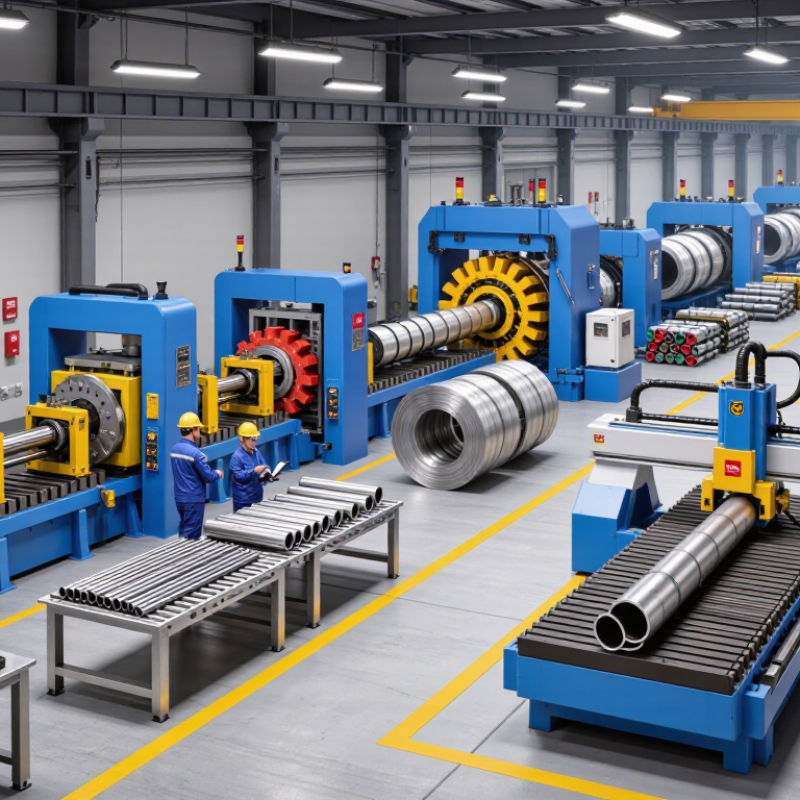
High-quality pipe equipment in 2026 covers more than cutting and forming machines. It includes CNC pipe cutters, precision benders, orbital welding systems, hydrostatic testers, and non-destructive inspection tools. Each type supports a different production risk. A modern CNC cutter can hold tight dimensional tolerances, while an orbital welder creates consistent joints around stainless steel tubing. Automated bending also reduces springback, but operators still need practical judgment.
Demand is closely linked to water, energy, and industrial construction. The International Energy Agency reported that global clean-energy investment could reach about 2 trillion dollars in 2024. This growth increases demand for reliable piping systems and traceable fabrication equipment. The International Trade Centre also shows strong international trade activity in tubes, pipes, and fittings, confirming the need for consistent quality across supply chains. These figures do not guarantee every equipment purchase will perform well.
Inspection equipment deserves equal attention. Ultrasonic testing, radiographic testing, laser measurement, and digital weld records help identify hidden defects. The ASME Boiler and Pressure Vessel Code remains an important technical reference for pressure-related fabrication. In practice, a polished machine can still produce poor results when calibration is neglected. That weakness is easy to overlook. Buyers should check repeatability, maintenance access, operator training, and data traceability before comparing prices. A high-quality system is not merely fast; it produces measurable results beside a clean, documented production line.
| Equipment Type | Primary Function | Typical Materials | Typical Capability Range | Key Quality and Performance Features | Common Applications | Relevant Standards and Practices |
|---|---|---|---|---|---|---|
| CNC Pipe Cutting Equipment | Produces accurate straight cuts, mitre cuts, holes, and profile shapes before fabrication or installation. | Carbon steel, stainless steel, alloy steel, aluminum, and copper alloys. | Approximately 20–1,500 mm outside diameter; wall thickness depends on the cutting process and machine configuration. | Servo-controlled positioning, automatic nesting, low heat-affected zones, repeatable tolerances, and digital production records. | Process piping, structural pipework, pressure vessels, shipbuilding, and modular fabrication. | Material traceability, drawing control, dimensional inspection, and project-specific fabrication specifications. |
| Cold Pipe and Tube Sawing Machines | Performs high-speed, low-deformation cutting with a circular saw blade or carbide tooling. | Steel, stainless steel, nickel alloys, aluminum, and non-ferrous tubing. | Commonly used for small- and medium-diameter tube and pipe; exact capacity varies by saw diameter and workholding system. | Clean cut faces, controlled burr formation, rigid clamping, automatic feed, and consistent cut length. | Heat exchangers, automotive tubing, instrumentation lines, and general pipe fabrication. | Dimensional tolerances, burr-control procedures, coolant management, and tool-life monitoring. |
| Pipe Beveling and End-Preparation Machines | Creates accurate weld bevels, square ends, counterbores, and compound preparations. | Carbon steel, stainless steel, duplex stainless steel, and high-alloy pipe. | Portable and stationary systems are available for small bore through large-diameter pipe. | Consistent bevel angle, controlled land thickness, minimal work hardening, low vibration, and repeatable surface finish. | Butt-welded pipelines, power piping, oil and gas construction, and prefabricated process modules. | ASME B16.25, project welding procedures, approved joint designs, and dimensional inspection plans. |
| CNC Pipe Bending Machines | Forms pipe and tube into precise bends while controlling ovality, wall thinning, and springback. | Carbon steel, stainless steel, copper, aluminum, and selected nickel alloys. | Typically supports small to medium diameters; bend radius and wall thickness depend on tooling and material. | Multi-axis control, programmable springback compensation, mandrel support, automatic lubrication, and bend-data storage. | Boiler tubes, HVAC systems, vehicle exhausts, hydraulic lines, and industrial piping. | Dimensional inspection, minimum bend-radius requirements, material-specific forming procedures, and customer drawings. |
| Orbital Tube and Pipe Welding Systems | Automates circumferential welding around tube or pipe to improve repeatability and weld consistency. | Stainless steel, carbon steel, duplex stainless steel, titanium, and nickel alloys. | Most common in small- and medium-diameter tubing and piping; current, gas flow, and travel speed are programmable. | Closed-loop control, controlled shielding gas, repeatable heat input, recorded weld programs, and reduced operator variability. | Pharmaceutical, semiconductor, food-processing, clean utility, power, and high-purity gas systems. | ASME Section IX, ISO 15614, ISO 9606, applicable hygienic requirements, and qualified welding procedures. |
| Pipe Threading and Grooving Equipment | Forms threaded or grooved ends for mechanical joints, valves, couplings, and detachable piping systems. | Carbon steel, galvanized steel, ductile iron, stainless steel, and selected plastic-lined pipe. | Commonly used for building services and industrial pipe sizes from small bore to large mechanical-joint sizes. | Accurate thread profiles, controlled groove depth, automatic gauging, stable clamping, and low-friction tooling. | Fire protection, water distribution, HVAC, compressed air, and utility piping. | ASME B1.20.1 for pipe threads, applicable grooved-joint specifications, and installation requirements. |
| Pipe Alignment and Fit-Up Systems | Centers, aligns, and holds pipe sections or fittings during tack welding and final joining. | Carbon steel, stainless steel, alloy steel, and lined pipe systems. | Internal and external clamps are available for a wide range of pipe diameters and wall thicknesses. | Reduced mismatch, controlled root gap, hydraulic or pneumatic actuation, accurate centering, and faster fit-up. | Pipeline construction, process modules, power plants, shipyards, and field repair work. | Welding procedure requirements, root-gap specifications, alignment tolerances, and project inspection plans. |
| Hydrostatic and Pneumatic Test Systems | Verifies pressure containment, leakage resistance, and system integrity after fabrication or installation. | Steel, stainless steel, ductile iron, plastic piping, and composite pipe systems where permitted. | Pressure capability is selected according to the design pressure, test code, component rating, and safety plan. | Calibrated pressure measurement, automated ramp control, data logging, controlled depressurization, and safety interlocks. | Process piping, water pipelines, fire systems, pressure equipment, and utility networks. | ASME B31.3, ASME B31.1, applicable API or EN requirements, calibrated gauges, and documented test procedures. |
| Ultrasonic and Other Nondestructive Testing Equipment | Detects internal or surface flaws without damaging the pipe, weld, or component. | Carbon steel, stainless steel, weldments, forgings, and selected non-metallic materials. | Inspection coverage depends on probe frequency, material thickness, geometry, access, and scanning method. | Phased-array imaging, encoded scanning, digital reporting, calibration verification, and defect location capability. | Weld inspection, corrosion mapping, pipeline integrity, pressure equipment, and maintenance programs. | ASME Section V, ISO 17640, ISO 13588, API inspection practices, and qualified NDT personnel requirements. |
| Pipe Coating and Surface-Treatment Systems | Cleans, prepares, coats, cures, or inspects pipe surfaces to improve corrosion and wear resistance. | Carbon steel, stainless steel, ductile iron, and coated or lined pipe substrates. | Capacity ranges from small-batch shop equipment to continuous large-pipe production lines. | Controlled surface profile, coating-thickness measurement, temperature monitoring, uniform application, and holiday detection. | Buried pipelines, offshore lines, water infrastructure, chemical plants, and industrial maintenance. | Surface preparation specifications, coating manufacturer procedures, ISO 8501, ISO 12944, and project coating requirements. |
Note: Capability ranges are typical industry ranges rather than universal specifications. Actual performance depends on machine design, tooling, pipe geometry, material grade, wall thickness, automation level, and the applicable project standard.


 English
 Russian
  German
  Spanish
  French
  Portuguese