SUNDI TOOLS
- Copyright © Wuxi Sundi Precision Tools Co.,LTD All rights reserved.
- Site Map
wine filters are quiet control points in modern winemaking. They can clarify wine, reduce suspended particles, and manage microbial stability before bottling. Their importance grows as producers protect consistency across large, international markets.
The International Organisation of Vine and Wine reported approximately 237 million hectolitres of global wine production in 2023. That scale makes reliable filtration increasingly practical, not merely cosmetic. The Australian Wine Research Institute also explains that filtration performance depends on pore size, membrane condition, wine composition, and sanitation. A filter is not a magic curtain.
Wine filtration specialist Gordon Burns, co-founder of ETS Laboratories, is often credited with this practical principle: “Filtration is a tool, not a substitute for sound winemaking.” The statement deserves careful attention. A depth filter may capture yeast and larger particles, while a membrane filter can provide tighter microbial control. However, excessive filtration may influence texture, aroma, or colloidal balance. The result depends on preparation.
This guide explains how wine filters work inside the cellar. It examines depth filtration, cartridge membranes, sterile filtration, and common filter ratings. It also considers pressure, flow rate, turbidity, and the risks of fouling. These details matter when a clear wine enters a clean bottle.
Reports from OIV and AWRI support the technical context, but real cellar decisions remain wine-specific. A young white wine may respond differently from an older red. That uncertainty is easy to overlook. Good filtration therefore combines laboratory testing, equipment records, sensory checks, and experienced judgment. Clear wine is useful. Preserved character is better.
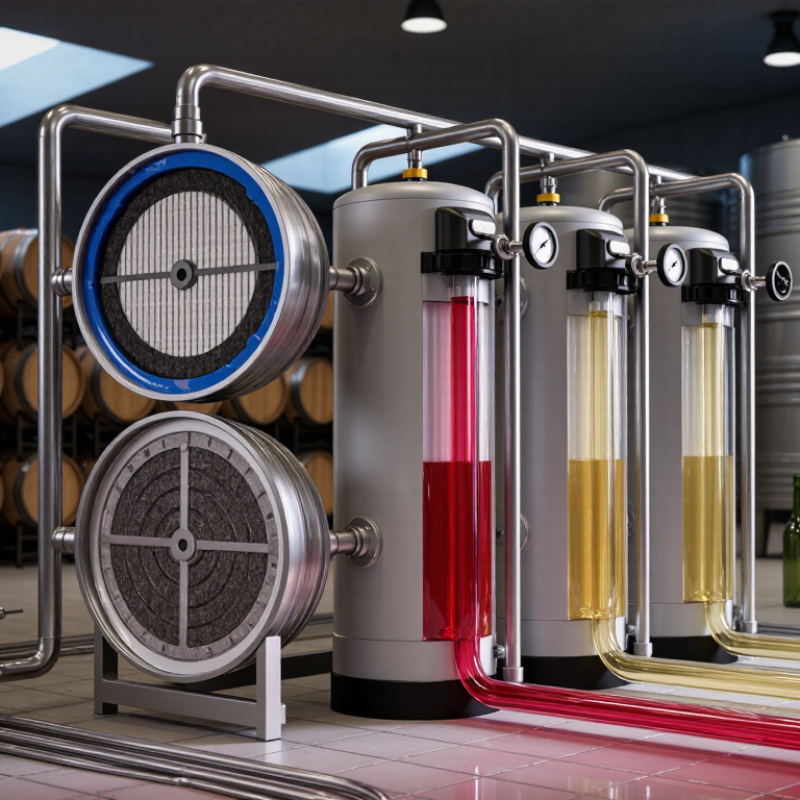
Wine filters remove unwanted particles before wine reaches the bottle. Their purpose is practical: improve clarity, protect stability, and reduce avoidable sediment. A filter may catch grape solids, yeast cells, crystals, or other fine particles. The process usually follows settling, racking, or clarification. Filtration alone cannot repair spoiled wine. It cannot hide poor hygiene.
Filter selection depends on the wine’s condition and production goal. Coarse filters remove visible material, while finer membranes target yeast and bacteria. The Australian Wine Research Institute identifies membrane filtration as a useful microbial-control step, with 0.45 micrometres commonly used for final filtration. However, tighter filtration can reduce flow and may slightly affect texture or aroma. The trade-off is real. Cleaner does not always mean better.
Scale also matters. The International Organisation of Vine and Wine estimated global wine production at about 237 million hectolitres in 2023. At that volume, consistent filtration supports repeatable quality across large lots (OIV, State of the World Vine and Wine Sector 2023). In smaller cellars, a producer may inspect the wine under strong light, test turbidity, and monitor pressure during filtration. Rising pressure often signals a blocked filter. That detail is easy to overlook. Filtration requires judgment, not just equipment. Excessive filtration can produce a bright but less expressive wine, so sensory checks should remain part of the decision.
What Are Wine Filters and How Do They Work?
How Wine Filtration Works from Preparation to Bottling
Wine filtration begins before the filter housing is opened. After fermentation, the wine may contain yeast, grape particles, and protein haze. Winemakers usually allow heavy solids to settle, then rack the clearer wine from the sediment. Temperature control helps, because cold wine can hold more visible crystals and particles.
Preparation matters. Lines, tanks, and filter sheets must be clean and properly sanitized. Operators wet the filter media with suitable water or wine before use. This reduces air pockets and helps prevent sudden pressure changes. During filtration, a coarse depth filter can remove larger particles. A finer membrane may follow when the wine needs stronger microbial protection.
Pressure matters. A rising gauge can signal a blocked filter or excessive solids. The wine may appear bright, but brightness alone does not prove stability. For wines intended for bottling, producers often check turbidity, dissolved oxygen, and microbiological condition. These tests support a safer, more consistent release.
Bottling requires gentle handling. The filtered wine travels through sanitized equipment, with minimal splashing and headspace exposure. A final sterile-grade filter may be used when the style and risk assessment justify it. However, filtration is not magic. Excessive filtration can reduce texture or delicate aromas. A slightly cloudy wine is not automatically defective, either. Careful trials are essential, and the best decision can remain imperfect.
| Winemaking Stage | Filter or Separation Method | Typical Retention Range | Primary Objective | How It Works | Important Quality Considerations |
|---|---|---|---|---|---|
| After Crushing and Pressing | Coarse screen or sieve | Approximately 100–1,000 micrometres (µm), depending on the screen opening | Remove stems, skins, seeds, and large suspended solids | The liquid passes through openings while larger particles remain on the screen surface. | This is a separation step rather than a polishing or sterile filtration step. Excessive pressure can increase solids transfer and oxidation. |
| Juice Clarification | Settling, flotation, or centrifugation | Removes larger suspended particles; no single pore rating applies | Reduce gross lees before fermentation | Gravity allows solids to settle, flotation gathers solids at the surface, and centrifugal force separates particles by density. | The desired clarification level depends on wine style. Removing too many solids may reduce nutrients needed for healthy fermentation. |
| Pre-Fermentation or Early Wine Transfer | Depth filter | Commonly about 1–5 µm nominal, depending on the filter medium | Reduce fine particles and protect downstream equipment | Particles are trapped throughout a thick porous medium rather than only on its surface. | Depth filters have high dirt-holding capacity but are not automatically sterilizing. Filter sheets or cartridges must be selected for compatibility with the wine and flow rate. |
| Post-Fermentation Gross Lees Removal | Racking followed by coarse or depth filtration | Often approximately 1–10 µm for the filtration portion | Remove yeast clumps, tartrates, and remaining suspended solids | Racking first removes settled solids; filtration then captures particles that remain suspended. | Wine temperature, viscosity, solids load, and filter area strongly affect throughput and pressure increase. |
| Pre-Bottling Polishing | Finer depth filter, lenticular filter, or cartridge filter | Typically about 0.6–2 µm nominal, depending on the system | Improve visual brightness and reduce fine haze-forming material | The filter medium retains progressively smaller particles as wine passes through under controlled pressure. | Polishing filtration does not necessarily remove all microorganisms. It is normally used after adequate clarification to prevent rapid filter blockage. |
| Microbial Stabilization Before Bottling | Membrane cartridge filter | Common final ratings include 0.45 µm or 0.65 µm; the effective performance depends on validation | Reduce viable yeast and bacterial passage before filling | A thin membrane with defined pores retains microorganisms primarily by size exclusion at the membrane surface. | A 0.45 µm rating is widely used for microbiological stabilization, but it should not be described as a guarantee of sterility without validated testing and hygienic bottling practices. |
| Crossflow Clarification | Crossflow membrane filtration | Often uses membranes in the approximate 0.1–0.2 µm range, depending on membrane design and process objective | Clarify wine continuously while reducing filter-cake buildup | Wine flows tangentially across the membrane surface. A portion passes through as permeate while retained solids remain in the circulating stream. | Crossflow can reduce consumable filter waste, but membrane fouling, transmembrane pressure, temperature, and cleaning procedures must be carefully controlled. |
| Bottling Line Protection | Final membrane filter installed close to the filler | Commonly 0.45 µm for validated microbial reduction applications | Limit contamination introduced between final filtration and filling | The membrane provides a final physical barrier immediately before the wine enters sanitized bottles. | Sanitation of hoses, tanks, filter housings, bottles, closures, and the filler is essential. A clean filter cannot compensate for contaminated downstream equipment. |
| Filter Performance Monitoring | Pressure, flow, turbidity, and microbiological checks | Set points vary by wine, filter type, and equipment design | Confirm consistent filtration and detect blockage or contamination | Operators compare inlet and outlet pressure, observe flow behavior, and test wine clarity or microbial status where appropriate. | A rising differential pressure usually indicates loading or fouling. Excessive pressure can damage equipment, reduce flow, or increase the risk of membrane or housing failure. |
Note: Micrometre ratings are typical industry ranges rather than universal specifications. Actual performance depends on wine composition, filter construction, operating pressure, temperature, flow rate, and validation testing.
Wine filtration is not one operation. It is a sequence of choices shaped by grape solids, wine style, and bottling risk. The International Organisation of Vine and Wine estimated 237 million hectolitres of wine production worldwide in 2023. That scale makes repeatable clarification essential, but filtration still requires cellar-level judgment.
Depth filters use cellulose, perlite, or diatomaceous earth to capture larger particles. They suit rough clarification after pressing or fermentation. Plate filters provide visible control, yet they may clog quickly when lees remain.
Crossflow filters move wine tangentially across a membrane. They continuously remove fine solids with limited filter-aid waste. Australian Wine Research Institute guidance notes that crossflow settings should protect aroma, color, and structure.
Membrane cartridge filters provide final polishing and microbial reduction before bottling. Ratings such as 0.45 micrometres are common, but pore size alone does not prove sterility. Integrity testing and hygienic handling matter.
They matter greatly.
Industry reports rarely quantify filter failure rates, which leaves room for better reporting. An overly tight filter can reduce texture, while an underperforming one can leave haze or spoilage risk.
In practice, I would test a small sample first. Compare aroma, turbidity, and flow rate before selecting the gentlest effective method. Small trials prevent expensive surprises.
Sources: OIV, State of the World Vine and Wine Sector in 2023; Australian Wine Research Institute, technical guidance on wine filtration.
What Are Wine Filters and How Do They Work?
How Filtration Affects Wine Clarity, Stability, and Flavor
Wine filters remove suspended particles before bottling. These particles may include yeast, grape solids, or harmless tartrate crystals. Depth filters trap material within layered pads. Membrane filters use fine pores and provide more precise microbial control. The right choice depends on wine style, condition, and bottling goals.
Clarity comes first. A well-filtered wine looks bright in the glass, with cleaner color and fewer visible sediments. Filtration can also improve stability by reducing yeast and bacteria that might cause renewed fermentation or unwanted aromas. This matters especially for wines with residual sugar. However, filtration is not automatically better. Excessive processing may reduce texture, aromatic intensity, or the soft impression of fruit.
The trade-off matters. In cellar trials, a wine may taste slightly quieter immediately after filtration. It can need time to recover in tank or bottle. Some winemakers therefore choose a lighter filtration level when the wine is already stable. Others prefer tighter filtration for dependable storage and consistent pouring. Testing before and after filtration helps reveal changes in aroma, palate weight, and finish. Results are not always predictable, and that uncertainty deserves attention. A perfectly clear wine is not necessarily the most expressive one.
What Are Wine Filters and How Do They Work?
Wine filters remove suspended particles, yeast, and selected microorganisms before bottling. They usually work through depth filtration or membrane filtration. Depth filters trap particles within layered material. Membrane filters use controlled pores at the surface. The pore size determines what can pass through.
Winemakers consider more than clarity when choosing a wine filter. The wine’s style matters. A delicate white wine may lose aroma if filtration is too aggressive. A structured red may need stronger particle removal after aging. Winemakers also check turbidity, alcohol level, viscosity, and microbial risk. Flow rate is important too. A blocked filter can raise pressure and slow production. Excess pressure may damage the wine’s character.
Small trials help reveal these effects.
Sanitation is another major factor. Filter housings, lines, and connections must be cleaned and handled carefully. Otherwise, a technically suitable filter may still create contamination risks. Dissolved oxygen also deserves attention, especially during transfer. Gentle pumping and limited exposure can protect freshness. In my experience, the “clearest” result is not always the best result. Some wines need stability, while others need a lighter touch. This decision requires laboratory data, sensory checks, and practical cellar judgment.
Tips: Test the wine before filtration. Compare filtered and unfiltered samples in a blind tasting. Record pressure, flow, turbidity, and sensory changes. Do not select a filter by pore size alone.
Winemakers choose filtration according to the desired clarity, microbial stability, wine style, and acceptable impact on aroma, color, and texture. Depth filters remove suspended solids through a porous medium, while membrane filters use a more uniform surface barrier. Lower pore ratings generally provide finer retention, but may require more pressure and can clog more quickly.
Values shown are representative filtration ratings commonly used in winemaking; actual operating ranges vary by filter material, wine composition, and process conditions.